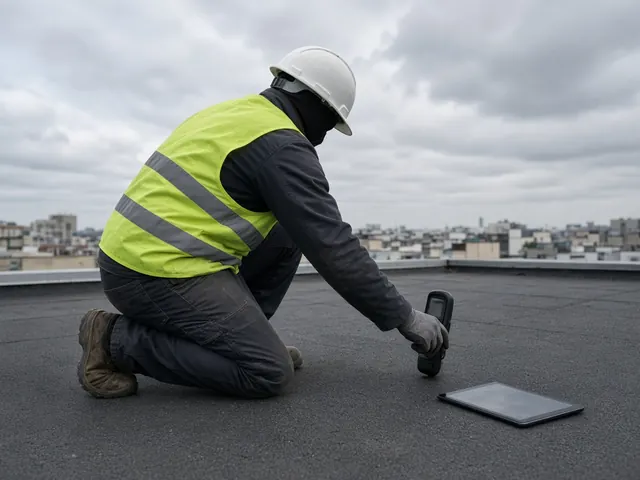
Water on a low-slope roof doesn't fall straight through. It enters at a seam, a flashing or a puncture, runs along the deck, the insulation joints or a rafter, and drips wherever it finds a gap. That's why "patch the spot above the stain" fails so often, and why good roofers trace first.
The most common entry points
- Flashings at walls and parapets. Membrane turned up the wall loses adhesion, termination bars loosen and sealant dries out.
- Penetrations. Pipe boots crack, pitch pans empty, and HVAC curbs lose their flashing.
- Seams. Aged EPDM splice tape lets go, and cold-weather TPO welds can be incomplete from day one.
- Drains and scuppers. Clamping rings loosen, and debris holds water against laps.
- Punctures. Dropped tools, foot traffic, hail and branches.
- Ponding areas. Water that sits for days finds every weakness and speeds up aging.

How a professional leak trace works
- Map the inside. Mark the stain locations on a sketch and note when they leak (every rain, only wind-driven rain, only after snow melt).
- Inspect the details upslope. Starting from the high side of the stain, check every flashing, penetration and seam.
- Probe the seams. On TPO and PVC a seam probe finds gaps in welds; on EPDM, lifted tape edges show up quickly.
- Water test in sections. Running a hose on one detail at a time, with someone inside, isolates the source.
- Check the insulation. Core cuts, a capacitance meter or an infrared scan show how far water has spread.
Temporary versus permanent repairs
A temporary repair keeps water out until the proper fix can be made: roofing cement and fabric on asphalt roofs, compatible tape on single-ply, or a weighted tarp over a large area. It's legitimate in an emergency, but it should be replaced with a permanent repair, made with the same membrane family as the roof and to the manufacturer's method, as soon as the weather allows. Our temporary fix guide covers what's safe to try yourself.
Typical leak repair costs
| Repair | Typical US range |
|---|---|
| Minor leak or puncture repair | $150–$500 |
| Typical repair job (national average range) | $300–$1,100 |
| Flashing repair | $200–$500 |
| Extensive leaks with structural damage | $1,200–$3,000 |
Frequently asked questions
Why is my flat roof leaking only when it's windy?
Wind-driven rain gets behind loose counter-flashing, coping joints and edge metal that stay dry in calm rain. Check parapet caps and wall flashings first.
Can I just put sealant on the leak?
As an emergency measure, sometimes. As a permanent fix, rarely. Sealants are not membranes, many are incompatible with single-ply roofs, and they hide the real defect. Use them only as a stopgap.
Will my insurance pay for a leak?
Sudden damage from a covered event such as a storm is often covered, while wear and lack of maintenance usually are not. See our storm damage and insurance guide.